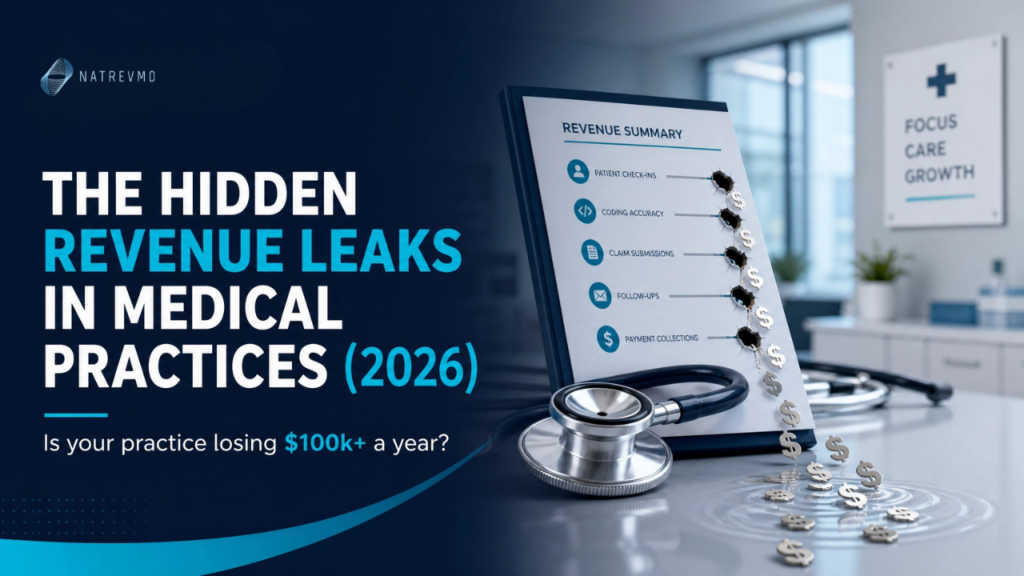
If you’re running a medical practice doing over $250,000 a month, there is a 90% chance you are leaking at least $100,000 a year in revenue. And the worst part? Your billing team probably has no idea it’s happening.
When most doctors think about “lost revenue,” they think about denied claims. But denied claims aren’t hidden. They’re sitting right there on your Accounts Receivable report. You can see them. You can work them.
A true revenue leak is invisible. It’s the money you earned but never even billed for. Or the money you billed for but got quietly taken back.
In 2026, these are the three biggest hidden revenue leaks we are seeing inside high-volume medical practices, why they happen, and exactly how to plug them.
Leak #1: The “Unsigned Chart” Black Hole
What it is: This is when a provider sees a patient, provides the care, but never officially closes and signs the encounter in the EMR. Because the chart isn’t signed, the billing team never drops the charge.
Why it happens: Most billing software is designed to pull completed encounters into the billing queue. If a chart is left open, the software assumes the visit isn’t finished yet. It doesn’t flag it as an error; it just ignores it. The provider thinks they’ll “get to it later,” the billing team assumes they’ve billed everything that was handed to them, and the claim simply ceases to exist.
Why it’s so dangerous: This is pure profit walking out the door. You already paid the overhead. You paid the staff. You paid the provider. You just didn’t collect the revenue. And if you wait too long to find these charts, you’ll miss the payer’s timely filing deadline, meaning you legally can’t get paid, even if you finally submit it.
How to plug the leak: You need an “Open Encounters” report run every single Friday afternoon. The Office Manager must pull a list of every appointment from that week where the chart is not signed. That list must be handed directly to the providers before they leave for the weekend. No one goes home with more than 3 open charts. If you don’t track what hasn’t been billed, you are losing money. Set the expectation upfront and track compliance weekly — this is a culture fix, not a one-time audit.
Leak #2: Silent Payer Recoupments
What it is: This is when an insurance company decides they overpaid you on a previous claim, so they quietly deduct that amount from your current check.
Why it happens: Payers audit their own payments constantly. If they find an error—maybe a coordination of benefits issue or a retroactive policy cancellation—they want their money back. But instead of sending you a bill, they just take it out of the next bulk payment they send you.
Why it’s so dangerous: Most in-house billing teams are overwhelmed just trying to post payments. When a $10,000 check comes in, but the ERA says $2,000 was recouped for old claims, the biller often just posts the $8,000 net amount and moves on. They don’t investigate why the $2,000 was taken back. This means you have no idea if the payer was actually right, and you lose the chance to appeal the takeback. It’s silent theft.
How to plug the leak: Your billing team must have a strict protocol for handling negative balances on ERAs. Every single recoupment must be logged and investigated. If the payer was wrong, you must immediately file an appeal. If the payer was right, you need to transfer that balance to the patient (usually a coordination of benefits issue) so you can actually collect it.
Leak #3: Chronic Under-Coding
What it is: This is when your providers consistently bill Level 3 visits (99213) for complex patients who actually qualify for a Level 4 (99214) or Level 5 (99215) visit.
Why it happens: Fear of audits. Many providers have been terrified by outdated compliance training into believing that billing a Level 4 or 5 will trigger an immediate Medicare audit. So, they play it safe. They downcode everything to a Level 3, even when they spent 40 minutes managing three chronic illnesses and adjusting two prescription medications.
Why it’s so dangerous: The difference in reimbursement between a 99213 and a 99214 is roughly $30 to $40 per visit, depending on the payer. If a provider sees 20 patients a day, and downcodes just 5 of them out of fear, that’s $200 a day. That’s $1,000 a week. That’s $50,000 a year—per provider—lost to fear.
How to plug the leak: You need to run a CPT Bell Curve analysis on your providers. Compare their coding distribution (how many 3s, 4s, and 5s they bill) against the national MGMA benchmarks for their specialty — your EMR or clearinghouse may already have this report built in. If you have an OB/GYN billing 80% Level 3s, they are leaking revenue. Bring in a certified coder to review 10 of their charts and show them exactly how their current documentation already supports the higher code. Don’t tell them to work harder; show them how to get paid for the work they are already doing.
Stop the Leaks Today
If you are a practice owner doing over $250,000 a month, these leaks are costing you real money right now. These leaks don’t fix themselves. The longer they go untracked, the more they cost you. Start demanding the data that actually drives your business.
Ready to find out if your practice is leaking money?
Take our free Practice Revenue Leak Scorecard — it takes 60 seconds and shows you exactly where your risks are. If your results say it’s time for a deeper look, you can book a complimentary call with our team directly from the results page