
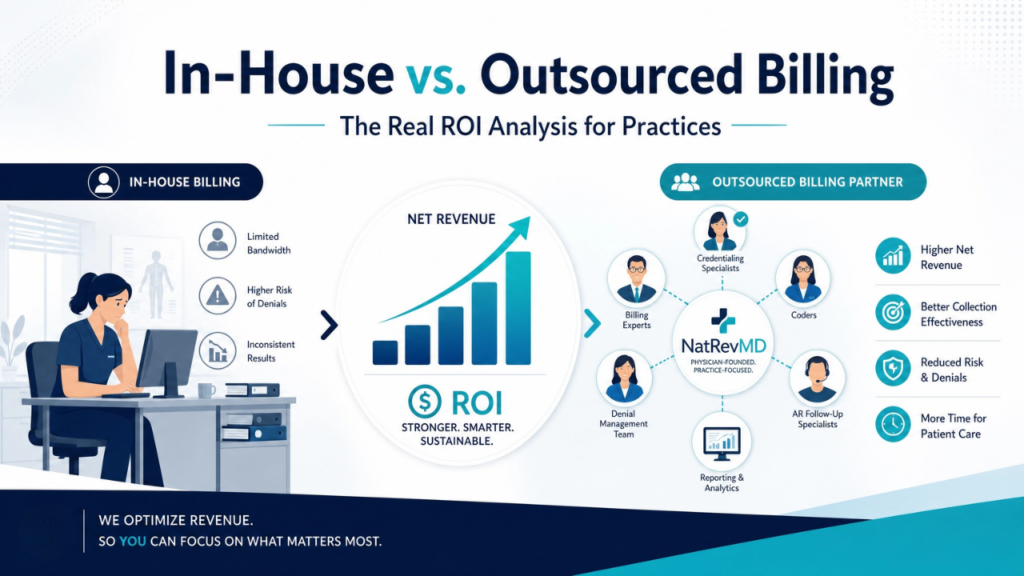
Most in-house versus outsourced billing comparisons are useless, because they compare the wrong things. They line up the salary of your biller against the percentage a billing company charges, decide the biller is cheaper, and stop there. That comparison misses almost everything that actually determines which option makes you more money. For a practice doing $200K or more per month in net receipts, the difference between a good billing decision and a bad one is not a rounding error. It is a meaningful share of your income. Here is the analysis that actually matters.
The Cost of In-House Is Never Just the Salary
When practices tally the cost of in-house billing, they usually count the biller’s salary and stop. The real cost is considerably larger. Add benefits and payroll taxes, which push the loaded cost well above the base salary. Add the billing software, the clearinghouse fees, and the ongoing training to keep up with coding and payer changes. Add the management time, yours or a manager’s, spent overseeing the function. And add the risk you carry when the entire revenue cycle depends on one or two people.
That last cost is the one practices feel only when it is too late. When your sole biller quits, goes on leave, or gets sick, your revenue cycle can stall. Claims age, denials pile up, and cash flow suffers, and the cost of that gap does not show up on any comparison spreadsheet until it hits your bank account. In-house billing concentrates a huge amount of financial risk in a very small number of people.
The Cost of Outsourced Is Not Just the Percentage
Outsourced billing typically costs a percentage of collections, and that number looks big next to a salary, which is why superficial comparisons stop there. But the percentage is not the whole picture either, in both directions.
On one hand, that percentage usually includes things you would otherwise pay for separately in-house: the software, the clearinghouse, the training, the staffing redundancy, the management. On the other hand, a percentage of collections scales with your revenue, so at higher volumes you are paying more in absolute dollars, which is exactly why a $200K-plus practice needs to run the real numbers rather than assume. The right question is not whether the percentage is bigger than a salary. It is what you get for it, and whether what you get produces more net revenue than the alternative.
The Number That Actually Decides It: Net Collections
Here is the pivot that most comparisons miss entirely. The real question is not which option costs less. It is which option collects more.
The practices we see leak 8 to 20 percent of recoverable revenue. On $200K per month, even the low end of that range is $16,000 a month, close to $200,000 a year, walking out the door. If one billing approach collects meaningfully more of what you are owed than the other, that difference swamps the cost comparison entirely. A billing operation that costs more but collects several percentage points more of your recoverable revenue is not more expensive. It is more profitable, by a wide margin.
So the analysis has to center on effectiveness, not just cost. What is the clean claim rate? How fast do denials get worked? What are the days in accounts receivable? What share of recoverable revenue actually gets collected? An option that saves you money on the invoice while quietly leaving revenue uncaptured is the expensive option, whatever the spreadsheet says.
When In-House Actually Makes Sense
In-house billing can be the right call under specific conditions. If you have enough volume to justify a properly staffed team with redundancy, not a single point of failure. If you have strong billing leadership who genuinely stays current on coding and payer changes. If your specialty is straightforward enough that the expertise is maintainable in-house. And if you want the tightest possible control and integration with your clinical operation.
The key is honesty about whether you actually meet those conditions. Many practices believe they have in-house billing under control when they are really running on one overextended person and a hope that nothing goes wrong. In-house done well can be excellent. In-house done thinly is a concentrated risk wearing the costume of cost savings.
When Outsourcing Wins
Outsourcing tends to win when you want redundancy and depth you cannot easily staff yourself, when you want specialized expertise that stays current without you managing it, and when you want to remove the single-point-of-failure risk from your revenue cycle. It also wins when you would rather your own attention go to running the practice than to managing a billing function you do not particularly want to run.
The critical caveat is that not all outsourced billing is equal. A cheap billing company that submits claims and ignores denials will leak just as much revenue as a weak in-house setup, and you will have paid a percentage for the privilege. What you want from an outsourced partner is aggressive, protocol-driven revenue capture, transparency into the metrics that matter, and, ideally, people who understand the clinical reality behind the codes. This is where being physician-led is not a slogan. It is the difference between a partner who understands why a claim looks the way it does and one who just pushes it through.
How to Actually Decide
Run the real ROI, not the surface comparison. Total the true, loaded cost of in-house, including the risk. Total the real cost of outsourcing, including what it replaces. Then, and this is the decisive step, compare the net collections each option realistically produces against your specific payer mix and volume. Whichever puts more money in your account after all costs is the right answer, and for a practice at $200K-plus per month, that answer usually turns on collection effectiveness, not on the invoice.
The honest verdict is that there is no universal right answer, only the right answer for your practice, your specialty, your volume, and your leadership. But the framework is universal: decide on net revenue captured, not on cost alone, and be honest about the risk you are carrying either way.
If you want to work through this decision with other independent physician owners who have run the numbers both ways, we built a community for exactly that kind of straight talk. Come join us. You will also find operational resources in our Trusted Resources hub at https://natrevmd.com/trusted-resources/.
When you run the numbers, our outsourced medical billing services are built to win this ROI comparison for practices doing $200K or more a month.
Join the community → https://www.skool.com/natrevmd-2370