
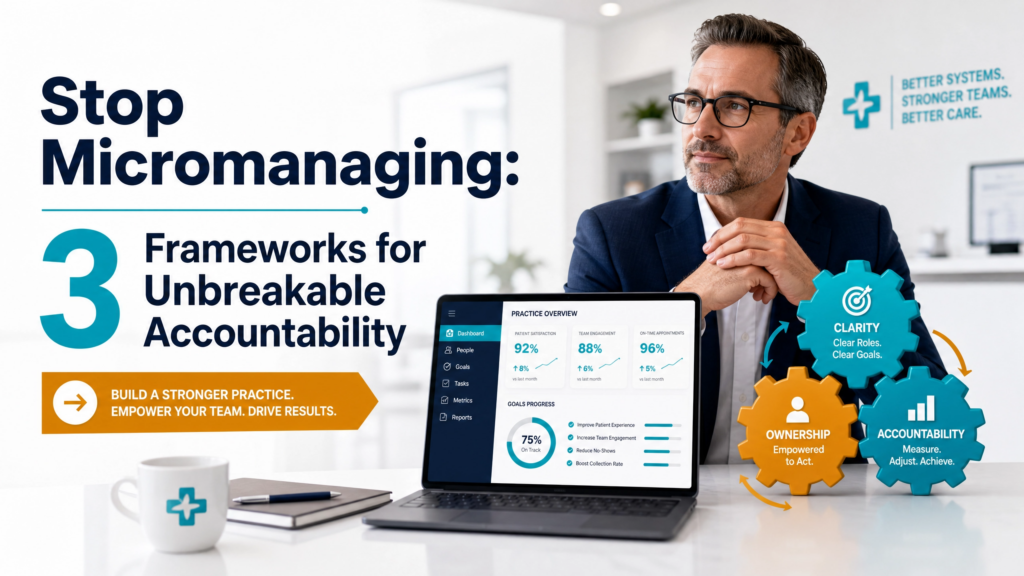
If you feel like you have to have your hands in every single part of your medical practice just to make sure things get done right, you don’t have a staffing problem. You have a systems problem.
Micromanagement is often a symptom of a practice that relies on people instead of systems. When you rely on people, you get guessing, errors, and burnout. When you rely on systems, you get predictable success — no matter who is sitting in the chair.
Here are three specific, high-yield frameworks you can implement in your practice right now to build unbreakable accountability, borrowing heavily from proven business methodologies like the Entrepreneurial Operating System (EOS)
Framework 1: The Accountability Chart (Not an Org Chart)
Most medical practices have an organizational chart that shows who reports to who. But an org chart tells you nothing about responsibility. What you need is an Accountability Chart.
In an Accountability Chart, you don’t list people’s names and titles. You list the core functions of the business, and then you define the 3 to 5 specific, measurable outcomes that function is accountable for.
For example, instead of a box that says “Sarah – Front Desk,” you have a box that says “Patient Intake & Registration.” Under that box, the accountabilities are:
- 100% of patients have eligibility verified 48 hours before their appointment.
- 95% of time-of-service copays are collected.
- Zero missing demographic fields in the EMR.
Then, you put Sarah’s name in that box. Now Sarah isn’t guessing what a “good job” looks like, and when a metric drops, you can have a targeted conversation about that specific outcome instead of micromanaging her entire day.
Framework 2: The Weekly KPI Scorecard
The second framework is the KPI Scorecard. This is how you manage the practice using data, instead of managing it using your gut feelings or by walking around looking over people’s shoulders.
Every person on your Accountability Chart should own at least one number on the weekly scorecard. Here are concrete examples of exactly what metrics you should be tracking and the industry benchmarks you should aim for.
Role
KPI
Target
Front Desk
Copay Collection Rate
95%+
Front Desk
Eligibility Verification Rate
100% (48 hrs in advance)
Billing Team
Days in A/R
30-40 days (best-in-class: <25)
Billing Team
Clean Claim Rate
95%+
Billing Team
Denial Rate
<5%
Clinical/MA
Pre-Visit Documentation Completion
95%+
Every week, you review these numbers as a leadership team. If a number is off track, you ask: “What is the root cause of this, and how do we fix the system so it doesn’t happen next week?” The data manages the team, not you.
Framework 3: “Who Not How” Delegation
When a problem arises, most practice owners ask, “How do I solve this?” That is the wrong question, and it leads directly to you doing the work yourself. The right question is, “Who can solve this for me?”
But you can’t just hand a problem to someone and walk away. To delegate effectively without micromanaging, you need Standard Operating Procedures (SOPs). An SOP is the “How” that you give to the “Who.”
When you have an SOP, you are no longer managing the person; you are managing the process. This removes the emotion, removes the micromanagement, and creates a culture where the systems run the practice, and the people run the systems.
Stop leaving money on the table. If your practice’s financial outcomes aren’t where they need to be, you need a better playbook. Go to natrevmd.com/margin-playbook to get our 2026 guide to protecting your revenue in the face of rising costs and declining reimbursements.
References
[1] Wickman, G. (2007). Traction: Get a Grip on Your Business. BenBella Books.
[2] Medical Billers and Coders. (2026, Jan 2).Net Collection Ratio Benchmarks for Multi-Specialty Groups. https://www.medicalbillersandcoders.com/blog/net-collection-ratio-benchmarks-multi-specialty-groups/ [3] Sullivan, D., & Hardy, B. (2020). Who Not How: The Formula to Achieve Bigger Goals Through Accelerating Teamwork. Hay House Business.