
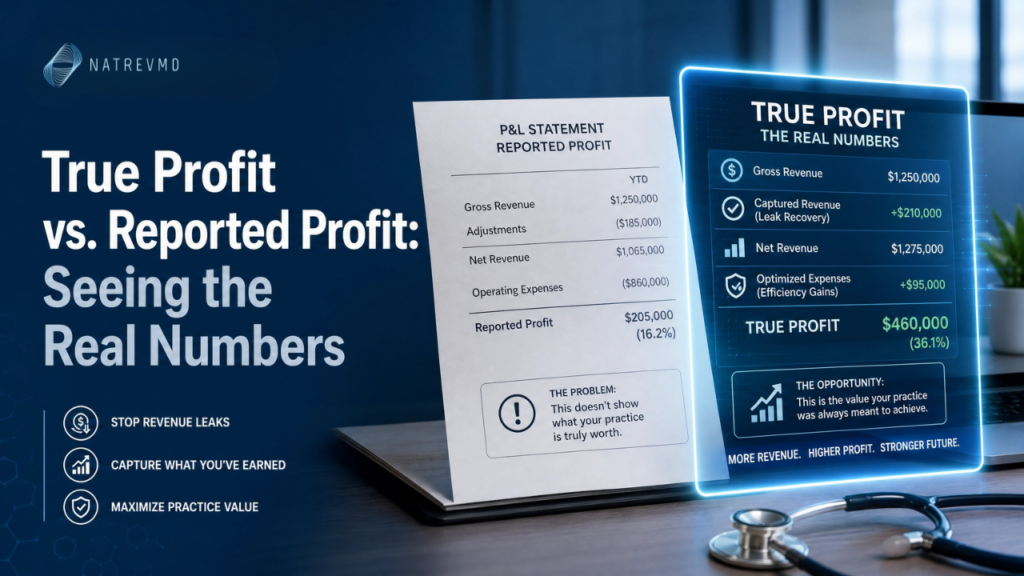
Ask most physician owners what their practice makes, and they will tell you a number from the bottom of their P&L. It is a real number. It is also, almost always, not the truth. Reported profit — the figure your accounting software produces — and true profit — what your practice actually generates as an economic entity — are two different things, and the gap between them is where owners quietly deceive themselves about the health of their business.
This is not an accounting technicality. It is the difference between believing you have a healthy practice and knowing whether you do. We will walk you through where the two numbers diverge and how to find the real one.
Reported profit hides your own labor
The most common distortion is the simplest. Reported profit usually treats whatever the owner happened to draw as the cost of the owner’s clinical work — and often that draw is set by what was left over, not by what the work is worth.
Here is the problem. If you are seeing patients 40 hours a week and paying yourself whatever remains after expenses, your “profit” is silently subsidized by your own underpaid labor. A practice that looks profitable only because the owner-physician is working full clinical hours for below-market compensation is not actually profitable — it is a job that occasionally leaves a tip. [EP174 — insert exact owner-comp example/figure here.]
To find true profit, separate the two roles. Pay yourself a fair market clinical wage for the clinical work you do — what you would have to pay an employed physician to replace yourself. Whatever the business generates above that is the true profit of the enterprise. If that number is thin or negative, you have learned something critical that the P&L was hiding.
Reported profit ignores revenue you never collected
The second distortion runs the other way, and it is bigger than most owners think. Your P&L reports revenue you collected. It says nothing about revenue you were owed and did not collect — the undercoded visits, the denied claims that were written off instead of appealed, the payer underpayments nobody validated, the AR that aged out.
Independent practices typically leak somewhere between 8 and 20 percent of recoverable revenue this way. That leaked revenue never appears on your P&L as a loss, because it never appears at all. It is invisible. So your reported profit can look stable while a meaningful slice of your true earning capacity is walking out the door unrecorded.
This is why true profit is not just reported profit adjusted for owner pay — it is reported profit measured against what the practice should have collected. A practice reporting a modest margin while leaking 15 percent of recoverable revenue is not a modest-margin practice. It is a high-margin practice with a hole in the boat.
Reported profit smooths over timing
Cash timing distorts the picture on a monthly basis in ways that fool owners into false confidence or false panic. A strong collections month can reflect work done 60 days ago, while a weak month can reflect a billing slowdown you have not noticed yet.
Because most practice P&Ls run on cash basis, this month’s reported profit is really a lagging echo of prior months’ work. If you make decisions on a single month’s number, you are steering by the rearview mirror. True profitability shows up in the trend across quarters, adjusted for the AR that has been earned but not yet collected. Look at rolling three-month figures, and always read your reported profit alongside your AR — because AR is profit that exists but has not arrived yet.
Reported profit buries owner-benefit expenses
Many practices run legitimate owner benefits through the business — vehicles, travel, retirement contributions, family members on payroll, continuing education that doubles as a nice trip. None of that is wrong. But it does mean the reported expense line overstates the true operating cost of running the practice.
To find true profit, add back discretionary owner benefits that are really compensation or personal spending in disguise. The point is not to change your tax strategy. The point is to see clearly. A practice that looks break-even on paper might be generating solid true profit once you strip out the owner’s discretionary spending that is running through the expense column. You cannot manage what you have deliberately obscured, even for good tax reasons.
How to actually calculate your true profit
Put it together and the calculation is straightforward, even if the data-gathering takes a weekend. Start with reported profit. Subtract a fair market clinical wage for your own hours. Add back discretionary owner benefits and personal spending. Then, separately, measure your recoverable revenue leak — the gap between what you collected and what you were contractually owed — because that leak is true profit you are eligible for but not capturing.
That gives you three numbers worth knowing: what the business truly earns above your clinical labor, what you are giving away in leakage, and what your practice would earn if the leak were closed. Most owners have never seen those three numbers side by side. Seeing them changes how you run the place.
The reason this matters is not vanity. It is that every real decision — whether to hire, whether to expand, whether to renegotiate a payer contract, whether you can finally pay yourself properly — depends on knowing the true number rather than the reported one. Running a practice on reported profit is running it half-blind.
Finding your true profit starts with finding your leak, because the leak is the piece your P&L can never show you. We built a diagnostic to surface exactly that gap.
Knowing your true profit starts with a clear-eyed medical practice revenue audit, the same one we run before we ever quote an engagement.
Run the diagnostic →Diagnostic Score Here