
Editor’s note: This piece was reviewed by Dr. Heather Signorelli, DO, as physician-reviewed operational guidance. It is not medical, legal, or compliance advice, and NatRevMD does not endorse any specific AI vendor. Verify any workflow against your own HIPAA and payer obligations.
A good appeal letter is not a form. It is an argument. The reason so many appeals fail is that they read like a shrug: “please reconsider this claim.” The reason so many succeed is that they make a specific, documented case for why the payer’s decision was wrong under the payer’s own rules. The problem for a small practice is that writing that kind of letter well takes time and a clear head, and denials tend to arrive in batches at the worst moments.
This is where a well-built prompt earns its keep. Not to send an appeal the AI wrote, but to get a strong, structured skeleton in seconds so your biller spends their time on the argument and the documentation instead of on the blank page. Here is the prompt we use, why it is built the way it is, and how to fill in the patient details without ever exposing them.
The prompt, written out
Here is the core template, built to run on de-identified inputs:
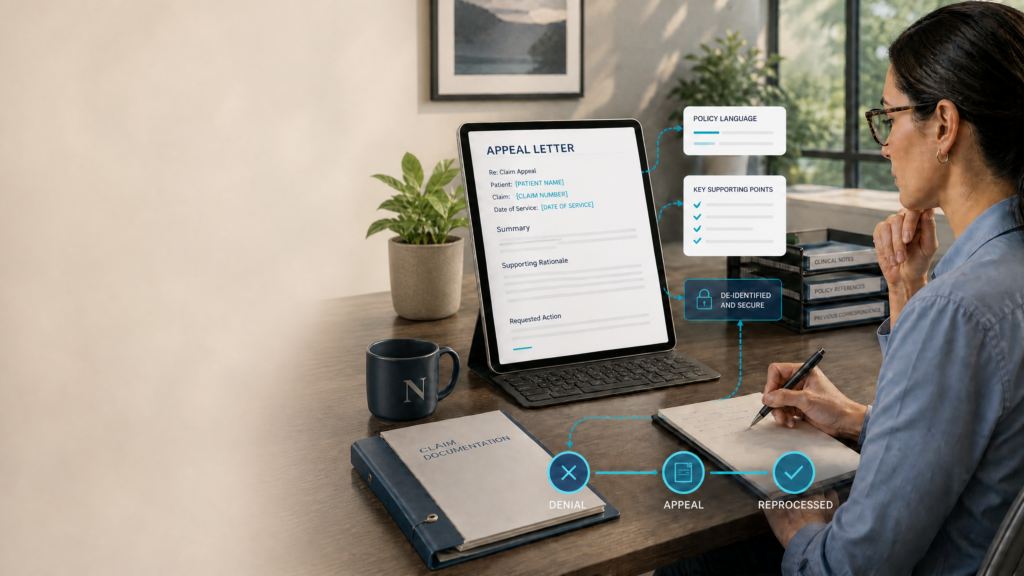
“Draft a professional insurance appeal letter for a claim that was denied. Denial reason: [reason in general terms, no PHI]. Service provided: [CPT or service type]. Clinical context: appropriate for a patient with [generic condition], no identifiers. Structure the letter with: a clear opening that states we are formally appealing, a concise statement of the clinical rationale, a reference to the relevant coverage or medical-necessity standard, and a specific request for the claim to be reprocessed. Leave bracketed placeholders for the patient’s name, date of birth, member ID, dates of service, claim number, and any specific clinical detail, which I will complete manually in our system. Keep it to one page and professional in tone.”
That is the whole thing. Notice what it does and, just as important, what it refuses to do.
Why it is built this way
The prompt does three deliberate things.
First, it never asks the AI for patient data and it explicitly leaves placeholders for every identifier. The AI drafts the argument; you supply the person, inside your own secure systems, by hand. That is the entire compliance posture in one design choice.
Second, it forces structure. An appeal that opens by stating it is a formal appeal, states the clinical rationale, references the applicable standard, and makes a specific reprocessing request is far harder for a payer to brush off than a vague reconsideration note. The structure is where the persuasion lives.
Third, it constrains length and tone. “One page, professional” keeps the AI from padding the letter with the kind of florid filler that makes a reviewer stop reading. A tight letter respects the reviewer’s time and gets to the point.
The step you cannot skip
The AI will sometimes reference a “policy” or a “medical-necessity standard” in a way that sounds authoritative and specific. Do not let that fool you. Before this letter goes out, confirm the actual standard, the actual policy language, and the timely-filing window against the payer’s own material or your contract. AI is excellent at structuring an argument and unreliable at inventing the citation that backs it.
So the workflow is: AI drafts the skeleton, a human confirms every payer-specific claim, and then the letter goes out. Skip the middle step and you risk appealing on a ground that does not exist, which wastes the appeal and the clock.
Filling in the PHI the right way
Here is the part that keeps this safe and still fast. The de-identified skeleton comes back with brackets everywhere a patient detail belongs. You take that skeleton into your EHR, billing platform, or word processor inside your own environment, and you fill in the real name, date of birth, member ID, dates, claim number, and specific clinical facts there, by hand. The PHI is entered where PHI is supposed to live. It never touched the AI tool.
This is the whole trick to using AI in a billing office without a breach. Draft de-identified, personalize in your secure system. Once your team internalizes that two-step rhythm, they stop even thinking about pasting a real EOB, because the workflow does not require it.
Make the argument stronger
A skeleton is a starting point. The letters that actually overturn denials are the ones where the biller adds the specific documentation the case needs: the relevant note excerpt, the supporting result, the reference to the exact coverage criterion the service meets. Use a follow-up prompt to sharpen the argument itself:
“Given a denial for [reason], list the two or three strongest angles for this appeal, ranked, and tell me what documentation each one requires.”
Now the biller knows what to attach and why, and the letter goes from a polite request to a documented case.
Consistency is the real win
The quiet benefit of a standardized appeal prompt is that every biller in the office produces the same quality of letter. Your newest hire drafts as clean an appeal as your most experienced one, because the structure comes from the prompt, not from years of practice. That consistency, repeated across every denial, is where the recovered revenue adds up.
We keep the full appeal prompt, the sharpening follow-ups, and the de-identification workflow together in our AI Kit, built and tuned for exactly this job. It is the same set our team uses on real appeals. If you want the wording and the process in one place, start there.
Turning a sharp appeal into overturned revenue is the daily work of our claim denial management services and insurance claim appeals service.
Get the AI Kit: https://eligibility.natrevmd.com/natrevmd-ai-kit-tool